Not medical advice. This content is for informational purposes only, backed by cited research. Consult a healthcare provider for personal guidance.
Gentle Overnight
Best Gentle Overnight Laxatives (2026)
Ranked by cramping and comfort rather than by the clock: the best-tolerated laxatives to take before bed if you want to sleep through the whole thing.
Evidence-basedUpdated 2026-07-12 · Sources cited below
OUR #1 PICK

MiraLAX
4.5 / 5
The lowest cramping burden of any overnight option — MiraLAX moves stool without forcing contractions, which is what earns it the top spot in a tolerability ranking.
You're constipated and you want it resolved by morning — but you also don't want to spend the night clutching your stomach. We hear you. This guide is about the second half of that sentence.
The ranking axis here is tolerability, not speed. Every product below is ordered by how much cramping, urgency, and general misery it imposes on an overnight dose — least first. Onset time is reported honestly for each one, but it does not move anything up or down the list. If your situation is the reverse and the stopwatch is what matters, this ranking will point you wrong: go to the laxatives ranked by how fast they work, which covers overlapping products in a completely different order because it scores time-to-effect first.
The short answer: MiraLAX taken after dinner will give most people comfortable, predictable results by morning or early the next day. If MiraLAX has been too mild for you in the past, Senokot is the mildest stimulant and a reasonable middle ground. And Milk of Magnesia is the wild card — easy on the intestinal muscles, but miserable to drink.
Why Does Gentleness Matter in a Laxative?
There's a common assumption that stronger laxatives are better laxatives. If you're really backed up, you want the most powerful option, right? Not necessarily — and here's why.
Stimulant laxatives work by forcing your intestinal muscles to contract. Those contractions are effective, but they're also what cause cramping, urgency, and that unpleasant "I need a bathroom right now" feeling. For some people, especially those prone to hemorrhoids or anal fissures, the straining and urgency from stimulant laxatives can actually make things worse by causing tears or swelling.
Gentle laxatives take a different approach. Osmotic laxatives like MiraLAX and Milk of Magnesia draw water into your intestines, softening stool so it passes naturally. Your intestinal muscles still do the work, but they're moving softer material at their own pace. The result: less cramping, less urgency, and a more natural-feeling bowel movement.
The tradeoff is time. Gentle options typically take longer to work. MiraLAX may need 12-72 hours (though most people see results within 24 hours). Senokot takes 8-12 hours but with milder contractions than Dulcolax. Milk of Magnesia splits the difference at around 6 hours.
How Did We Choose These Products?
Speed carries no weight in this ranking. Comfort carries almost all of it:
Gentleness — 35% (the defining criterion — how little cramping and urgency does this cause?) Overnight Reliability — 25% (will you have results by morning if you take it before bed?) Safety for Repeat Use — 20% (can you use this more than once without concern?) Side Effect Profile — 10% (bloating, gas, nausea, other issues) Value — 10%
We specifically excluded products that regularly cause severe cramping, even when they are the fastest thing on the shelf — which is exactly why Dulcolax tops a speed ranking and doesn't appear here at all. This is the guide for people who want to sleep through the process and wake up to a comfortable morning.
Two of these three products are close enough on tolerability that the choice comes down to format and mechanism. PEG 3350 against sennosides is the decision most readers actually face — no-contraction osmotic versus mildest stimulant — while the powder-versus-liquid osmotic comparison covers the two non-stimulant options and the kidney question that separates them.
Should You Choose Osmotic or Stimulant?
Every gentle laxative falls into one of two categories, and understanding the difference helps you choose:
Osmotic laxatives (MiraLAX, Milk of Magnesia) draw water into the colon through osmosis. The extra water softens stool and increases its volume, which gently triggers your body's natural urge to have a bowel movement. Because no artificial muscle stimulation is involved, cramping is minimal. These are safe for daily use.
Stimulant laxatives (Senokot, Dulcolax, Ex-Lax) trigger nerve signals that cause your intestinal muscles to contract more forcefully. They're faster and more predictable, but the forced contractions cause cramping. We included Senokot on this list because it's the mildest stimulant — its nerve-mediated action produces gentler contractions than Dulcolax's direct muscle stimulation.
Studies comparing the two categories consistently show that osmotic laxatives produce fewer adverse effects, particularly less abdominal pain and cramping. A 2019 network meta-analysis found that PEG-based osmotics (like MiraLAX) had the best efficacy-to-side-effect ratio across all OTC laxative types.
How Should You Take Them for Overnight Results?
Timing matters more than most people realize, and each product has its own sweet spot:
MiraLAX (full product review): Mix one capful (17 grams) into 4-8 ounces of any beverage after dinner, ideally around 7-8 PM. For many people, this produces a comfortable bowel movement by mid-morning. If you're a first-time user, be patient — the first dose may take 24-48 hours. Subsequent doses are more predictable. You can also take a second dose the following morning if needed.
Senokot (what senna actually does): Take one to two tablets at bedtime, roughly 2-3 hours after your last meal. Expect results in 8-12 hours — so a 10 PM dose should produce results around 6-10 AM. Start with one tablet your first time; you can increase to two if one tablet doesn't produce results.
Milk of Magnesia: Take 2-4 tablespoons at bedtime. It's the fastest of the three gentle options, often working within 6 hours. The challenge is actually getting it down — the thick, chalky consistency is genuinely difficult for most people. Mixing it with a small amount of juice can help mask the texture, though nothing fully eliminates it.
What If Gentle Overnight Doesn't Work?
Sometimes you've tried the gentle route and it hasn't worked. Here's how to troubleshoot:
If MiraLAX isn't working after 3 days, try increasing your water intake significantly. MiraLAX works by drawing water, so if you're dehydrated, there's less water available to draw. Many "non-responders" see results when they increase their daily water intake by 3-4 glasses.
If Senokot is causing too much cramping, drop to half a tablet. You can also try taking it earlier in the evening so the peak cramping happens while you're still awake, rather than waking you from sleep.
If Milk of Magnesia causes watery stools, your dose is too high. Start with 2 tablespoons instead of the full 4-tablespoon dose. You can always increase — but starting too high leads to uncomfortable, watery results that feel worse than the original constipation.
If none of these are working, the issue may not be something an OTC laxative can resolve. Chronic constipation that doesn't respond to osmotic laxatives, stimulant laxatives, or fiber deserves a conversation with your doctor. There may be an underlying cause — from pelvic floor dysfunction to medication side effects — that requires targeted treatment rather than another OTC product.
Who Should Use a Different Guide?
This guide isn't the right fit if you need results in under 6 hours — that scenario is ranked separately by onset time. It's also the wrong guide if the texture of Milk of Magnesia is your sticking point; our magnesium hydroxide review is blunt about how hard it is to get down. It's also not ideal if your constipation is chronic and daily — in that case, a fiber supplement like Metamucil used consistently will serve you better than repeated laxative doses. And if you're pregnant, our pregnancy-safe laxatives guide covers which products are approved for that specific situation.
For everyone else — people dealing with occasional constipation who want to take something before bed and wake up feeling normal — one of these three options will get you there comfortably.
#1
Our Pick
MiraLAX
4.5 / 5
Our Pick
MiraLAX
4.5 / 5
osmoticOnset: 1-3 days
“Unflavored powder dissolves completely in any liquid — truly tasteless, which is its biggest advantage over flavored competitors.”
MiraLAX is the gold standard for gentle overnight relief. It works osmotically — drawing water into your intestines to soften stool — rather than forcing muscle contractions. Take a dose dissolved in any beverage after dinner, and most people see results within 12-24 hours. The tradeoff: it's slower than stimulant options, and some people need 2-3 days of use before the first result. But for comfort, nothing OTC beats it.
Minimal cramping compared to stimulant laxatives
Tasteless and dissolves completely in any drink
Safe for long-term daily use
Slower than stimulant options — may take 1-3 days
First-time users sometimes need 2-3 doses before results
Can cause bloating during the first few days
$29.97 ($1.11 / ounce)
Amazon price as of Oct 21, 2026
#2

Runner Up
Senokot
4 / 5
Runner Up
Senokot
4 / 5
stimulantOnset: 6-12 hours
“Small brown tablets with a faint herbal smell. The gummy form tastes like a slightly earthy mixed berry — better than expected for a laxative, but not something you'd eat for fun.”
Senokot is a stimulant laxative, but it's the milder one. Senna produces noticeably less cramping than bisacodyl (Dulcolax), making it a solid middle ground for people who need overnight results but found Dulcolax too aggressive. Take it at bedtime and expect results in 8-12 hours. It's still a stimulant, so we don't recommend daily use, but for occasional gentle overnight relief, it strikes a good balance between speed and comfort.
Works overnight — results typically in 8-12 hours
Milder cramping than bisacodyl-based products
Plant-based active ingredient (sennosides from senna leaf)
Still a stimulant — not for daily or weekly use
Cramping is reduced but not eliminated
Timing can be unpredictable (6-14 hour range)
$19.89 ($0.20 / count)
Amazon price as of Oct 21, 2026 · currently unavailable
#3
Best Liquid
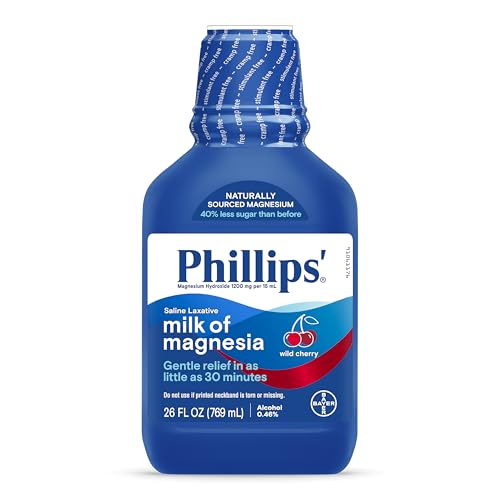
Phillips' Milk of Magnesia
3.3 / 5
Best Liquid
Phillips' Milk of Magnesia
3.3 / 5
osmoticOnset: 30 minutes - 6 hours
“Thick, chalky white liquid that coats your mouth. The unflavored original tastes exactly like liquid chalk. The mint and cherry flavors mask it somewhat, but the texture is the real challenge — think melted ice cream consistency but chalky.”
Milk of Magnesia is an osmotic laxative like MiraLAX, but it works faster — often within 6 hours. Taken at bedtime, a standard dose usually produces results by early morning. The gentleness factor is real: magnesium hydroxide softens stool without stimulating contractions, so cramping is minimal. The downside is the thick, chalky texture that most people genuinely dislike, and it's not safe for anyone with kidney problems.
Osmotic action means minimal cramping
Faster than MiraLAX — often works within 6 hours
Liquid format allows precise dose adjustment
Thick, chalky texture is hard to tolerate
Unsafe for people with kidney disease
Can cause watery stools if dose is too high
$8.98 ($0.35 / fluid ounce)
Amazon price as of Oct 21, 2026
Product Comparison
| Product | Type | Active Ingredient | Onset | Price | Rating | Best For |
|---|---|---|---|---|---|---|
| MiraLAX | osmotic | Polyethylene Glycol 3350 (PEG 3350) | 1-3 days | $29.97 | Daily use | |
| Senokot | stimulant | Sennosides (Senna) | 6-12 hours | $19.89 | Overnight relief (gentler than Dulcolax) | |
| Phillips' Milk of Magnesia | osmotic | Magnesium Hydroxide | 30 minutes - 6 hours | $8.98 | Fast liquid relief |
Amazon prices as of Oct 21, 2026. “Typically” figures are our estimate of usual retail cost, not a live price.
When to See a Doctor
OTC products work well for most people, but see a doctor if you experience any of the following:
- •Constipation persisting beyond 2 weeks despite OTC treatment
- •Blood in your stool or on toilet paper
- •Unexplained weight loss alongside constipation
- •Alternating constipation and diarrhea (could indicate IBS)
- •Severe bloating or abdominal distension
Frequently Asked Questions
Fast-acting laxatives (like Dulcolax) prioritize speed — they force intestinal contractions to produce results in 6-8 hours, but often cause significant cramping and urgency. Gentle overnight laxatives prioritize comfort — they soften stool or draw water into the intestines so results happen naturally with minimal pain. The tradeoff is that gentle options may take slightly longer (12-24 hours for MiraLAX, 6-12 hours for Milk of Magnesia).
Yes, MiraLAX is safe for daily use. Many gastroenterologists recommend it as a daily maintenance laxative for people with chronic constipation. That said, if you need it every day for more than two weeks, it's worth seeing a doctor to investigate the underlying cause.
Both are stimulant laxatives, but they work through different mechanisms. Senokot (sennosides) primarily stimulates the nerves in the colon wall, while Dulcolax (bisacodyl) directly stimulates smooth muscle contractions. The nerve-mediated action of senna tends to produce more gradual, less intense contractions, which most people experience as milder cramping.
MiraLAX works fine with or without food — most people mix it into an evening beverage. Senokot works best taken 2-3 hours after dinner, at bedtime, so it activates while you sleep. Milk of Magnesia also works best on a relatively empty stomach, taken at bedtime. For all three, timing the dose for bedtime produces the most comfortable experience.
Related
Sources
- Comparison of efficacy of pharmacological treatments for chronic idiopathic constipation: a systematic review and network meta-analysis (2017)
- Efficacy and Safety of Over-the-Counter Therapies for Chronic Constipation: An Updated Systematic Review (2021)
- Senna Versus Magnesium Oxide for the Treatment of Chronic Constipation: A Randomized, Placebo-Controlled Trial (2021)
Medical Disclaimer
This content is for informational purposes only and does not constitute medical advice. Always consult a healthcare professional before starting any new medication or supplement, especially if you are pregnant, nursing, taking prescription medications, or have a pre-existing medical condition. Product recommendations are based on publicly available clinical research and are not a substitute for professional medical guidance. Read our full disclaimer.
This article contains affiliate links. We may earn a commission at no extra cost to you. See our full disclosure.